
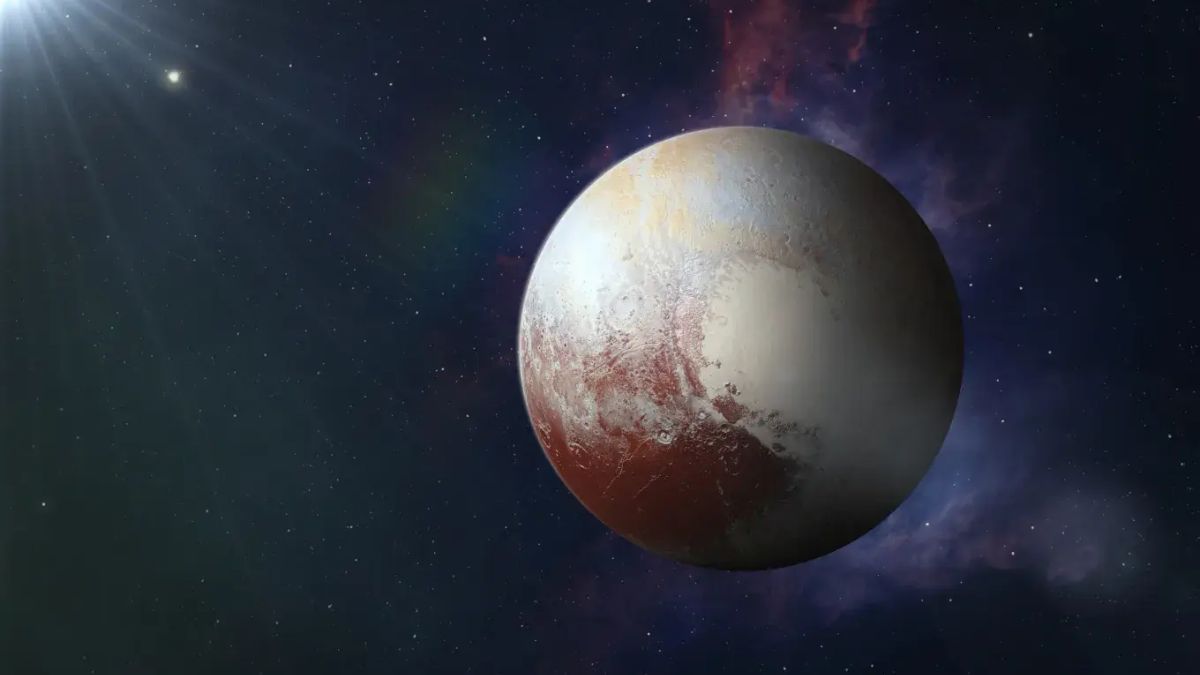
Just when we thought Pluto had settled into its identity as a dwarf planet, science throws us a cosmic curveball. Recent studies have revealed that Pluto’s atmosphere is unlike anything we’ve seen in the Solar System—it’s foggy, full of haze particles that act very differently from what scientists expected.
Table of Contents
This discovery didn’t just surprise astronomers—it challenged long-standing ideas about cold, distant worlds. So, let’s unpack what’s going on with this hazy little planet.
Dwarfs

First, what even is a dwarf planet?
To be considered a full planet, a celestial body needs to do three things: orbit the Sun, be round in shape, and clear its orbit of other debris. Dwarf planets fail the third requirement—they don’t dominate their orbit, which is why Pluto lost its full-planet status in 2006.
But that doesn’t make them any less interesting. In fact, Pluto might be one of the most fascinating ones of all.
Pluto

Pluto sits way out near the edge of the Solar System, beyond Neptune, in a region known as the Kuiper Belt. It’s tiny, cold, and distant—far too small to be a gas giant, and not quite like the rocky planets either.
It also has a large moon called Charon, and the two orbit each other in a sort of cosmic dance. This unique Pluto-Charon system gave astronomers the perfect chance to study Pluto in detail using a spacecraft called New Horizons.
That’s where this whole foggy business begins.
Discovery

When New Horizons flew past Pluto in 2015, it snapped high-resolution photos and collected data that revealed something completely unexpected: Pluto’s atmosphere isn’t clear—it’s full of fog.
Yes, fog. The kind made up of haze particles that form high in the atmosphere, warm up during the day, and cool down at night. These particles create layers that stretch for hundreds of kilometers, wrapping Pluto in a fuzzy glow.
This effect hasn’t been seen anywhere else in the Solar System—not on planets or moons. That makes Pluto’s atmosphere one-of-a-kind.
Telescopes
How did scientists confirm all of this?
They didn’t just rely on the old data from New Horizons. They turned to NASA’s James Webb Space Telescope (JWST), one of the most powerful space tools available today. The JWST uses infrared light to detect things the human eye could never see—especially useful for analyzing distant, dark, cold objects like Pluto.
One scientist, Xi Zhang, had proposed a bold idea: that this haze could actually be cooling Pluto. At the time, it sounded ridiculous to many.
But another astronomer, Tanguy Bertrand, found evidence using JWST data that confirmed Zhang’s theory. The haze doesn’t just sit there looking pretty—it regulates energy on the planet. It controls how much heat gets in and how much escapes.
In other words, Pluto has a self-regulating atmosphere, like an insulating blanket in space.
Importance
Why does this matter?
First, it proves that even small and distant planets like Pluto can have complex and dynamic atmospheres. This challenges what we know about how planets work, especially the cold ones way out on the edge of our solar neighborhood.
Second, this could open up new studies on similar moons and planets, like Triton (Neptune’s moon) and Titan (Saturn’s moon), both of which are also cold and show signs of weird atmospheres.
And third, it’s a big win for scientists like Xi Zhang, whose out-of-the-box ideas help push our understanding of space. Turns out, Pluto’s fog isn’t just real—it might be the key to learning about other icy worlds in our Solar System and beyond.
Once again, science proves that no idea is too far-fetched, and no planet is too small to surprise us. Who knows what’s next—maybe a fog-covered moon orbiting a planet we haven’t even discovered yet?
FAQs
What is new about Pluto’s atmosphere?
It has haze particles, making it look foggy.
How was Pluto’s fog discovered?
Using New Horizons and the James Webb Telescope.
Why is Pluto not a full planet?
It doesn’t clear its orbit, so it’s a dwarf planet.
Who predicted Pluto’s fog?
Astronomer Xi Zhang, later confirmed by data.
What does this mean for science?
It helps us study cold, foggy atmospheres elsewhere.