When astronomers captured the first image of a black hole in 2019, the world was stunned. That blurry orange ring? It wasn’t just a photo—it was proof. And the black hole at the heart of that image, M87*, is turning out to be even more fascinating than we thought. It’s massive, fast-spinning, and actively shaping the galaxy around it.
Table of Contents
Let’s break down this cosmic monster in the most human-friendly way possible. Because trust us—this black hole is more than just a pretty space picture.
M87*
M87* is the black hole sitting right in the middle of the elliptical galaxy Messier 87, around 55 million light-years away from Earth. This is no ordinary black hole—it has a mass of 6.5 billion Suns and was the first black hole ever directly photographed by humanity, thanks to the Event Horizon Telescope (EHT) in 2019.
Now, scientists have gone one step further: they’ve measured its spin. And what they found is mind-blowing.
Spin
Let’s talk speed.

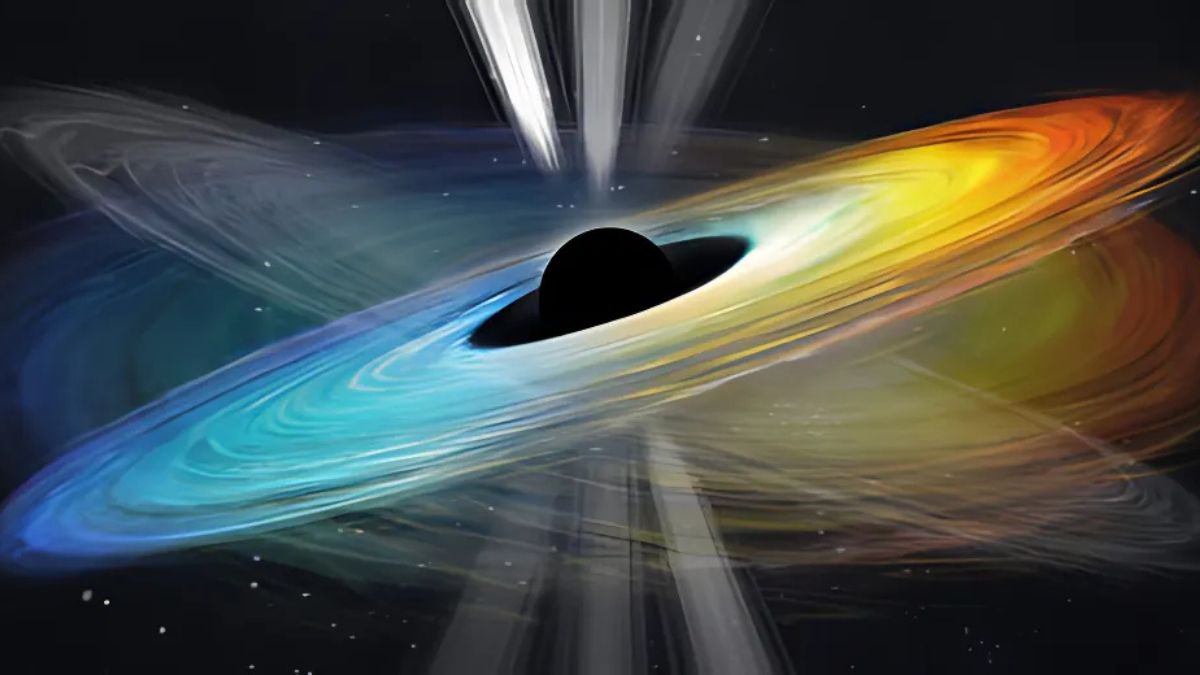
Black holes spin. But M87* doesn’t just rotate—it nearly pushes the limits of physics. Based on the data, researchers calculated a spin value of 0.8, on a scale where 1 is the maximum possible value. That’s 80% of the fastest a black hole can theoretically spin.
So how did they figure this out? It all comes down to light.
Ring
The now-famous ring of light around M87* revealed something more than just its shape. It showed uneven brightness, a telltale sign of the relativistic Doppler effect. This is a phenomenon where light appears bluer when an object moves toward us and redder when it moves away.

By observing these shifts in light, scientists measured the speed of the glowing plasma swirling around the black hole. The result? The plasma closest to M87* is spinning at an insane 42 million meters per second—that’s about 14% the speed of light.
Feeding
M87* isn’t just spinning fast—it’s eating, too.
Matter around the black hole spirals inward, eventually falling past the event horizon. According to recent studies, material is falling in at nearly 25% of the speed of light, and the black hole is feeding at a rate between 0.00004 and 0.4 solar masses per year.
Even though that sounds huge, it’s still below the so-called Eddington limit—the threshold where radiation pressure would push matter away instead of letting it fall in. This tells us M87* is feeding calmly but steadily.
Jet
Here’s where it gets even cooler.
M87* emits a relativistic jet—a powerful beam of particles that stretches for thousands of light-years. It was once thought this jet might be an unrelated phenomenon. But now we know: it’s directly connected to the black hole’s feeding process.
As material falls in, some of that energy is transferred into the jet, blasting matter outward at near light-speed. M87* is literally shaping its galaxy, clearing out gas and dust, and possibly even influencing how stars form.
Importance
So, why should we care about the spin of a black hole?
The spin tells us how the black hole twists space-time around it. It also helps explain how jets are formed and how galaxies evolve over time. High-speed spin can drive stronger jets, and those jets can disrupt or slow down star formation in the galaxy.
Before the EHT, we mostly relied on X-ray data to estimate black hole spin. But the new technique using light brightness and Doppler shifts is much more direct and reliable.
Frontier
M87* is more than just a black hole. It’s a cosmic laboratory. Its extreme physics, from relativistic motion to space-time warping, gives scientists a place to test Einstein’s theory of general relativity and the most extreme fluid dynamics in existence.
And here’s the kicker: that spin value of 0.8? It might be an underestimate. Some scientists suggest the real value could be closer to 0.998, pushing M87* almost all the way to the theoretical speed limit.
With each new discovery, this black hole challenges our understanding of gravity, motion, energy—and even how the universe works.
FAQs
How fast is M87* spinning?
At 80% of the maximum speed allowed by physics.
How was the spin of M87* measured?
By using the Doppler effect in the light ring.
What is the Eddington limit?
The max energy before light pushes matter away.
What is M87*’s mass?
It has a mass of 6.5 billion times that of the Sun.
What causes the jet from M87*?
The energy from falling matter powers the jet.