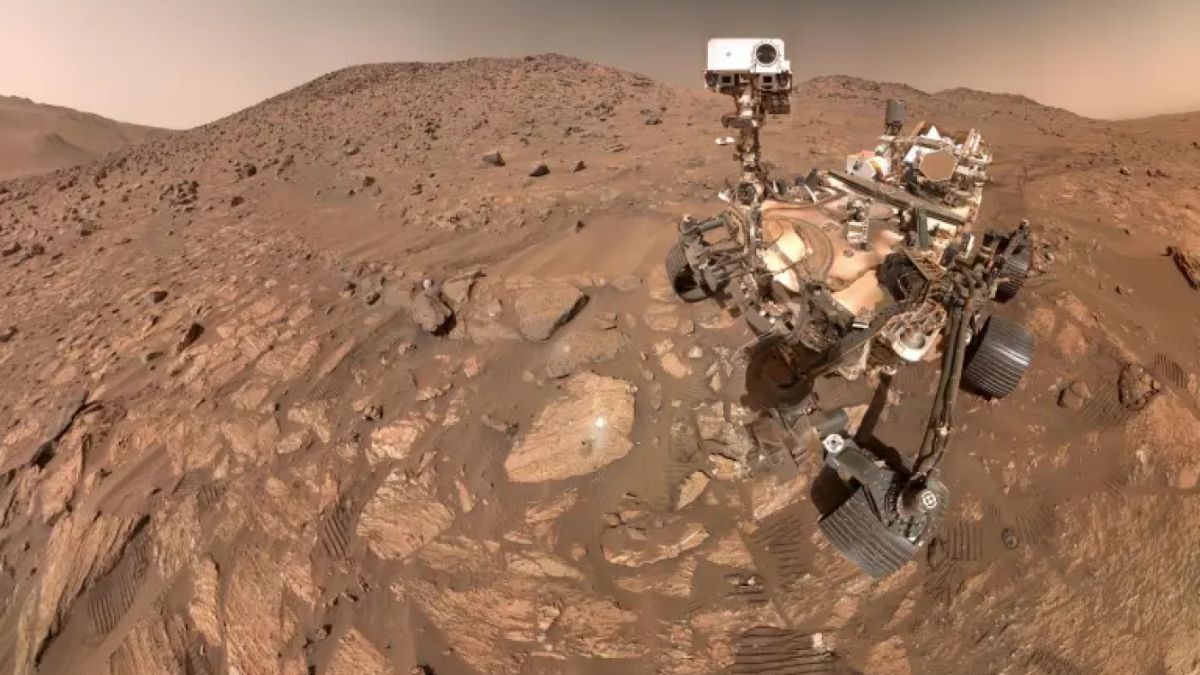
NASA has just made one of its most exciting discoveries on Mars — one that could change everything we thought we knew about life in the universe. The Perseverance Rover, exploring a region known as Sapphire Canyon, found chemical traces in a Martian rock that may have come from ancient biological activity. Yes, you read that right — we might be looking at evidence of past life on Mars.
Table of Contents
No, it’s not Martians or alien cities, but the chemical fingerprint of microbial life, possibly preserved in minerals that formed billions of years ago in what was once a watery environment.

Let’s break down what this discovery means — and why it’s at risk of being lost due to budget cuts.
Sapphire
The rock in question, nicknamed Sapphire Canyon, held dark mineral spots rich in iron, phosphorus, and sulfur. These are elements that, on Earth, are closely linked to the metabolic processes of microorganisms — especially in watery, low-oxygen environments.
Scientists identified minerals like:
- Vivianite
- Greigite

These aren’t just random Martian minerals. On Earth, they typically form through chemical reactions triggered by organic matter — meaning living or once-living organisms. That’s a massive clue.
Instruments aboard Perseverance, such as SHERLOC and PIXL, analyzed the rock and found textures suggesting it had been part of a wet, habitable environment. And where there’s water and organic chemistry, the chance of past life skyrockets.
Meaning
So, what does this all mean?

According to Nicky Fox, NASA’s associate administrator of science, this is “the closest we’ve ever come to discovering ancient life on Mars.”
This doesn’t mean there’s life on Mars today, but it does point to the real possibility that microbial life existed billions of years ago. The signs are all there — water, organic compounds, and the types of minerals formed by biological processes.
Still, some scientists like Joel Hurowitz urge caution. There’s a chance that non-biological processes, like volcanic heating, could also create similar minerals. So while the clues are compelling, they are not yet conclusive.
Limits
There’s just one problem: Perseverance has done all it can.
The rover wasn’t designed to fully confirm life from the Martian surface. Its mission is to find, collect, and store promising samples — to be retrieved and studied back on Earth. That’s where real answers can be found.
But here’s the frustrating part: the program responsible for returning these samples, the Mars Sample Return (MSR) mission, is on the chopping block.
MSR
The original plan was that, together with the European Space Agency, NASA would send a mission to pick up the tubes collected by Perseverance and bring them home by around 2035.
But now, due to delays and rising costs, the White House has proposed cancelling the MSR mission in the 2026 budget, calling it “economically unfeasible.”
NASA is now scrambling to find cheaper alternatives, but no detailed plan has been announced. Scientists are worried — and rightly so. Without those samples coming back, this potential life discovery could remain a mystery forever.
Budget
It’s a classic case of science vs. money. Just as we find the most promising clue of life beyond Earth, the funding disappears. It’s like reaching the final page of a mystery novel — and finding it’s been torn out.
The MSR mission isn’t just another space project. It’s the only way to truly confirm if Mars once hosted living organisms. Without access to Earth’s laboratories, microscopes, and advanced testing, we’re left with speculation.
Opportunity
The discovery in Sapphire Canyon is more than exciting — it’s a unique scientific opportunity. If confirmed, it would be the first time in history we’ve found direct evidence that life existed outside Earth.
That could reshape how we understand:
- The origin of life
- How common life is in the universe
- Whether Earth is truly unique or just one of many planets that have hosted life
Even if it was just microbes, it answers one of the biggest questions in science: Are we alone?
Right now, everything depends on NASA finding a way to bring those samples back. Because if we miss this chance, we may have to wait decades before another opportunity like this comes around.
FAQs
What did NASA find in Sapphire Canyon?
Minerals that may have formed through ancient biological processes.
Does this mean Mars had life?
It’s possible — the chemical clues strongly suggest microbial life.
Can Perseverance confirm life alone?
No, it can collect samples, but lab analysis on Earth is needed.
Why is the Mars Sample Return delayed?
High costs and budget issues have led to proposed cancellation.
Is there still hope to retrieve samples?
NASA is seeking cheaper options, but no final plan exists yet.